|
|
MS3112 Hydrogen Penetration Monitoring System |
View PDF version 
User's Manual in PDF |
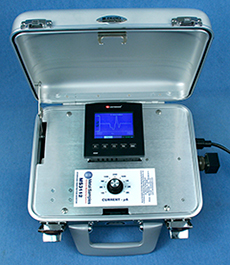
The Hydrogen Penetration Monitoring System™ provides a method for directly measuring the rate of hydrogen migration through a vessel or pipe wall. This method actually measures the penetration current set up by the hydrogen as it moves through the steel. By sensing and recording this data directly from the pipe wall, this system offers valuable data which can only be indirectly inferred by other methods.
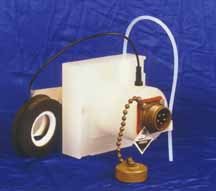
The Hydrogen Patch Probe™ (see below) can be mounted directly to the outside of the pipe wall by simple mechanical straps tightened with a screwdriver. No welding or tapping is required. The patch probe can be installed or moved to a new location in less than one hour.
|
 |
Operation
One of the common corrosion products of iron or steel in a neutral or acidic medium is atomic hydrogen. Normally, these highly reactive species combine with other hydrogen atoms to produce a relatively harmless molecule, hydrogen gas (H2). In the presence of some catalysts such as sulfur, arsenic, or tin, the hydrogen atoms dissolve into the steel to a significant degree.
The Hydrogen Penetration Monitoring System measures hydrogen moving through a pipe or vessel wall. Since the hydrogen produced by the corrosion reaction occurring inside the pipe or vessel often produces severe structural damage to steel, especially in highly stressed or high strength alloys, it is valuable to be able to monitor the hydrogen penetration rate.
Discussion
The MS3112 instrument and the HYY00330100 Hydrogen Patch Probe are quickly and easily installed at virtually any corrosion monitoring site. The pipe to be monitored is first surface cleaned. Then a transfer medium (paraffin wax) and a small piece of .010" palladium foil are placed on the pipe to be monitored. The electrochemical patch probe is then mounted over the foil. A pair of gaskets and an insert, shaped to the general contours of the pipe, provide a leak-tight seal against the foil. The cell is then filled with a suitable electrolyte. When the palladium foil is polarized by the MS3112 instrument, the foil acts as a working electrode, quantitatively oxidizing the hydrogen as it emerges from the pipe wall. After an initial pumpdown period, the current indicated by the instrument is directly equivalent to the real-time hydrogen penetration rate.
Since the instrument/probe is measuring the hydrogen penetration rate, the user gets fast response to changes in the system being monitored. Significant changes can be seen in less than two hours. The instrument instantaneously measures and records penetration current from a low of 10 microamps full scale to a high of 5000 microamps full scale. Its digital recorder charts the hydrogen penetration rate on-screen, and stores the data to a microSD flash memory card. Data can be reviewed on-screen and can be downloaded to a PC for printing and analysis. |
|
|
Technical Specifications
|
| Model |
|
| MS3112 - Hydrogen Penetration Monitoring System (Ordering # IN3112) |
| |
|
| Physical Data |
|
| Instrument Weight: |
6.6 lb. (3 Kg) |
| Total Weight w/ Accessories: |
7.6 lb. (3.45 Kg) |
| Instrument Dimensions: |
5.25" H x 12.25" W x 10.5" D (13.34cm x 31.12cm x 26.67cm)*
* Including handle and feet. |
| |
|
| Performance Data |
|
| Measurement Type: |
Hydrogen Penetration |
| Range: |
Switch Selectable Ranges from 10µA to 5000µA |
| |
|
| Electrical Data |
|
| Power Requirements: |
100-240VAC, 50/60 Hz |
| Output Specifications: |
> 5 years of data storage (depends on configuration) |
| |
|
| Special Features |
|
- Integrated digital recorder
- Data stored to microSD flash memory card
- On-screen data review
- Switch selectable range
- Portable
|
| |
|
| Included Accessory Items |
|
| Meter Prover,
AC Power Cable, Operation Manual, microSD Flash Card |
| |
| Optional Accessory Items (sold separately) |
Hydrogen Patch Probe - Part # HYY00330100
Palladium Foil - Part # PS5576718
Instrument-to-Probe Cable - Part # PS5547LLL (LLL = length in feet, specify required length) |
|
Hydrogen Patch Probe™ - HYY00330100 |
| Materials of Construction: Viton®, Polypropylene, Teflon®, Kalrez® |
 |
| References and Auxiliary Electrodes: Hastelloy C-276 |
| Working Electrode: Palladium foil (sold separately) |
| Electrolyte: 96% H2S04 - cell volume 40 ml |
| Temperature Range: -10°F to +290°F |
| Hydrogen Penetration Monitoring System™ and Hydrogen Patch Probe™ are trademarks of Metal Samples Company.
Teflon® is a registered trademark of Dupont. Viton® and Kalrez® are registered trademarks of DuPont Dow Elastomers. |
|
|
MS3112 Ordering Information |
|
|
|
Optional Accessory Items
|
|
|
|